The Pocket Watch to the Wristwatch: How Timekeeping Became Wearable
Pocket watch to wristwatch history shows how a change in placement reshaped timepiece design, dress and daily habits, with useful context for reading each style.
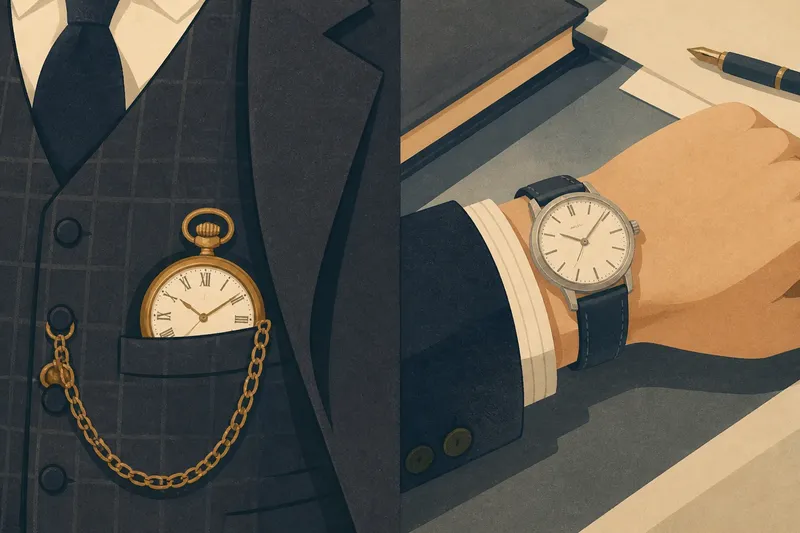
The pocket watch to wristwatch shift is often reduced to a simple swap, but the change was gradual and shaped by clothing as much as by timekeeping. A watch carried in a waistcoat pocket belonged to a different set of garments and gestures from one fastened to the wrist.
How did a pocket watch fit into dress?
A waistcoat pocket offered a snug place for a watch, with a chain secured to a buttonhole or another fastening point. The chain helped keep the watch from slipping away and let its wearer draw it out without gripping delicate parts of the case. Pocket watches could also be carried in trouser pockets or other secure garment pockets, depending on the clothing.
Because the timepiece was concealed between checks, the chain often provided its most visible clue. It might be plain or decorative, chosen to sit comfortably alongside the waistcoat and other details of dress. The watch’s pocket was not merely storage: it helped determine how the object appeared and how it was handled.
How did wristwatches gain acceptance?
There was no single moment when pocket watches gave way to wristwatches. Wrist-worn timepieces existed before they became familiar everyday accessories, and their early uses and associations varied with period, place and social custom. In some settings, wristwatches were associated with women’s dress, while men’s watches were commonly carried in waistcoat or trouser pockets; this is a broad description of clothing conventions, not a universal rule.
As wrist-worn designs became more practical for everyday activity, they offered a different way to consult the time: the wearer could turn an arm rather than retrieve an object from a pocket. Military use helped make wristwatches more visible among men in circumstances where pocket access was inconvenient. That development contributed to changing perceptions, but did not instantly end the pocket watch’s place in dress.
What did the new position change?
A wristwatch stayed attached to the wearer through movement. Its case sat against the wrist, and its strap or bracelet became part of the visible design. Sleeves and cuffs framed the dial, making the watch easier to notice even when nobody was checking the time.
A pocket watch, by contrast, was carried within a garment and brought out for use. Its relationship with clothing depended on a suitable pocket and, often, a chain. The difference was not simply convenience: one form was usually tucked away, while the other became a visible element of an outfit.
Say a fictional clerk carries a pocket watch in a waistcoat while working at a desk. They must reach for the pocket and draw out the watch to read it; later, they wear a wristwatch with a strap and turn their arm to see the dial. The expected observable result is that the watch remains fastened in place and visible at the wrist, rather than being removed from the garment for each check.
How did watch design respond?
A pocket watch has a case suited to being held, opened and protected in clothing. Its crown or winding control is commonly positioned at the top, near the point where a chain can attach. A wristwatch needs an attachment system, such as lugs, to connect its case to a strap or bracelet.
The two formats also invite different ways of reading the dial. A pocket watch can be turned in the hand and brought closer to the eyes. A wristwatch is read while worn, so the face needs to be legible as the arm is raised or rotated. Both forms need protection, but the wristwatch is more exposed to its surroundings during ordinary wear.
Straps and bracelets became important parts of the wristwatch’s appearance as well as its fit. Leather can make the watch sit quietly with clothing; a metal bracelet gives the band a more prominent visual role. Buckles and other closures hold the case in position. There is little value in treating one material as universally smarter: the useful choice depends on the outfit, comfort and the watch itself.
What do readers ask about the pocket watch to wristwatch shift?
Why did wristwatches suit some activities better?
A wristwatch could be read by turning the arm, without retrieving a separate object from a pocket. That made its position useful in situations where pocket access was awkward.
Did wristwatches immediately replace pocket watches?
No. The forms coexisted, and pocket watches continued to suit people whose clothing and habits accommodated them. Changes in fashion and use took place unevenly.
How can you tell a pocket watch from a wristwatch?
A pocket watch is designed to be carried in a garment pocket and may have a chain attachment. A wristwatch is secured to the wrist by a strap or bracelet, making its means of attachment part of its visible form.
Why is a wristwatch more visible in an outfit?
It sits outside the pocket, where the case and band may appear beside a sleeve or cuff. A pocket watch is generally hidden until its wearer takes it out.
What does the pocket watch still offer in dress?
A pocket watch connects closely to the garment that carries it. It calls for a suitable pocket and, where needed, a secure chain; its case and chain can also make a deliberate dress detail. A wristwatch instead makes the wrist its home, with the band and dial contributing directly to the outfit’s visible balance.
For anyone comparing the pocket watch to wristwatch transition, the most useful distinction is not which form is better, but how each works with clothing. Consider where the timepiece sits, how it is secured and whether you want it tucked away or visible. Those choices explain much of the difference in their design and role in dress.